Apparently, we're all terrified of cortisol now.
According to social media, cortisol is making you fat, stopping you from losing weight, ruining your sleep and apparently responsible for every problem you've ever had.
But here's the thing.
Without cortisol, you'd literally be dead.
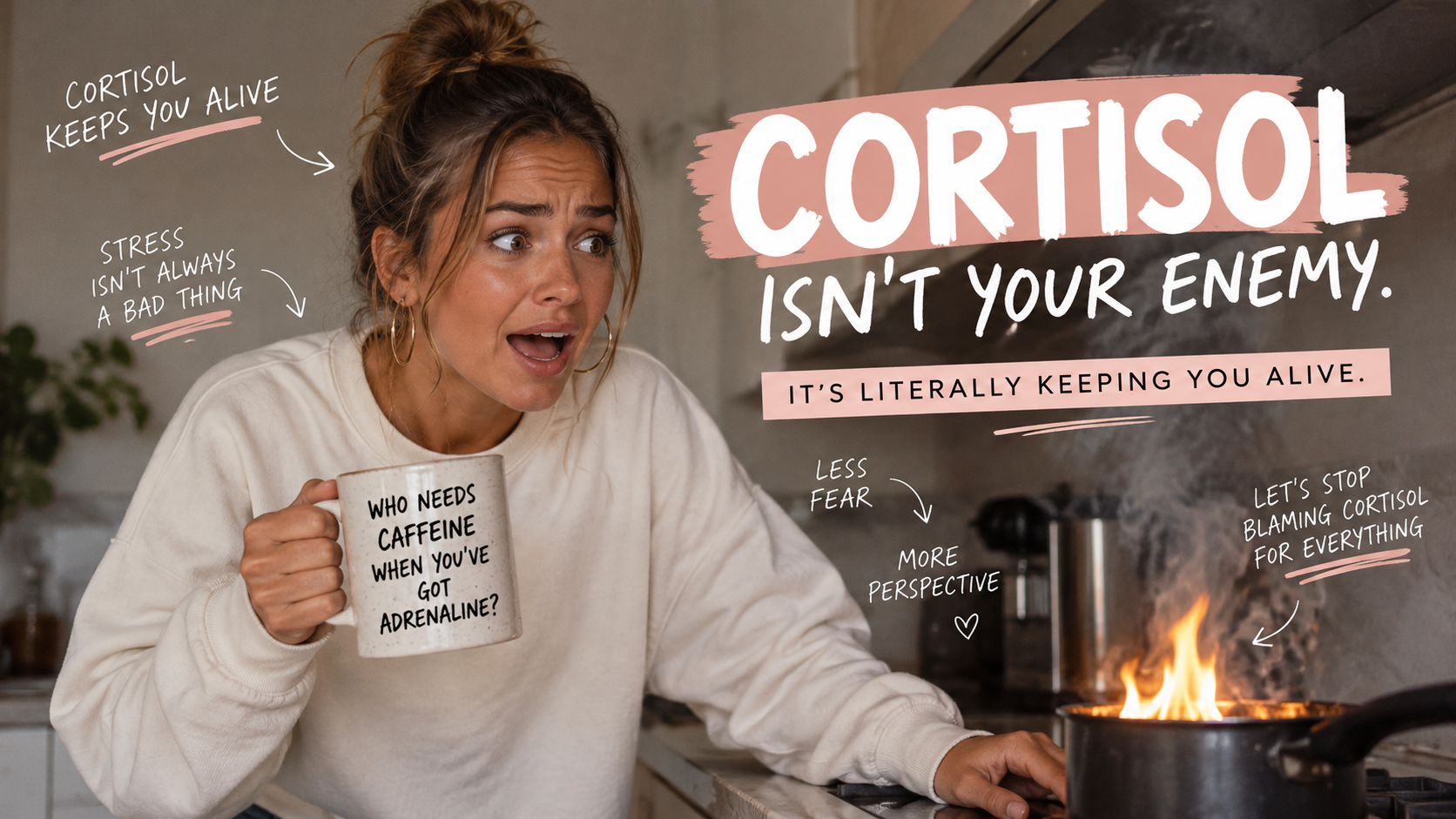
And I was reminded of just how useful our body's stress response is this morning when I nearly set my apartment on fire.
Yes, really. 😂
There I was, just trying to make my morning coffee, when suddenly I was having a much more eventful morning than I'd planned.
My heart was racing, I was wide awake and I can assure you the last thing on my mind was whether my cortisol levels were too high.
Who needs caffeine when you've got adrenaline?
But it actually got me thinking.
We've become so obsessed with trying to lower cortisol that I think we've forgotten why our bodies produce it in the first place.
And spoiler alert, it's not just there to make you fat.
So, what actually is cortisol?
You've probably heard cortisol referred to as the stress hormone.
Which isn't wrong, but it's also a pretty rubbish way of explaining something that does so much for your body.
Cortisol is a hormone produced by your adrenal glands, and it plays a really important role in keeping you alive and functioning properly.
It helps your body:
- Manage and use energy.
- Regulate blood pressure.
- Control inflammation.
- Maintain a healthy sleep-wake cycle.
- Respond to stressful situations.
Pretty important stuff, right?
And here's something that might surprise you.
Your body produces cortisol every single day, whether you're stressed or not.
In fact, cortisol naturally rises around the time you wake up.
That's NORMAL.
It's part of how your body prepares you for the day ahead.
So when you see someone on Instagram telling you that your morning cortisol spike is something you need to fix, please remember that your body is quite literally doing what it's supposed to do.
Your stress response has kept humans alive for thousands of years
Let's go back to my slightly traumatic coffee-making experience.
When I realised something was going wrong, my body didn't stop and think:
"Hang on Poppy, we can't be increasing your stress hormones, you're trying to lose body fat."
No. 😂
My body immediately responded to what it recognised as a potential threat.
My heart started racing, I became much more alert and suddenly I was moving a hell of a lot faster than I normally do at that time in the morning.
That's your fight-or-flight response.
Adrenaline is responsible for much of that immediate reaction, while cortisol helps support your body's response to stress over a slightly longer period.
And there's a very good reason we have this system.
Think about our ancestors.
If they came face-to-face with a dangerous animal, they needed their bodies to react quickly.
They didn't have time to sit there worrying about whether their cortisol was going to give them belly fat.
They needed to RUN.
And although most of us aren't running away from wild animals anymore, that same stress response still exists.
It's there to protect us.
Stress hormones aren't automatically a bad thing. They're part of what allows us to respond when something actually matters.
So why is everyone suddenly terrified of cortisol?
Because social media absolutely LOVES finding something new to blame for everything.
First, carbohydrates were making us fat.
Then insulin was the problem.
Now apparently cortisol is the reason you can't lose your belly fat.
And you've probably seen some of these claims yourself.
"Your cortisol is stopping you from losing weight."
"Stop doing intense exercise because it spikes cortisol."
"Don't drink coffee in the morning because it raises cortisol."
"You need to balance your cortisol to lose belly fat."
And this is where I get frustrated.
Because there are little bits of truth behind some of these claims.
But when you take something complicated, remove all the context and turn it into a scary Instagram reel, people start worrying about things they really don't need to worry about.
Just because something increases cortisol doesn't mean it's bad for you.
Exercise increases cortisol.
Waking up increases cortisol.
Stressful situations can increase cortisol.
And guess what?
That's completely normal.
The problem isn't that your cortisol increases.
It's when cortisol levels are abnormally high for prolonged periods, or when your body isn't regulating them properly.
And those are two very different things.
But doesn't cortisol cause belly fat?
Ahhh, the big one.
This is probably the claim I see most often.
And I think it's important we actually understand what's going on here.
Because yes, prolonged exposure to excessively high cortisol can affect where your body stores fat.
We see this in medical conditions like Cushing's syndrome, where the body is exposed to too much cortisol over a long period of time.
But that is NOT the same as having a stressful day at work or doing a hard gym session.
And it certainly doesn't mean that every woman struggling to lose belly fat has a cortisol problem.
Now, can stress make fat loss more difficult?
Absolutely.
But often not for the reasons social media would have you believe.
Think about what happens when you're really stressed.
Maybe you're not sleeping very well.
You're exhausted, so you can't be bothered cooking.
You find yourself snacking more.
Your cravings are through the roof.
You skip the gym because you've had a shit day.
And you're generally moving less because you're absolutely knackered.
All of those things can affect your ability to lose body fat.
But notice something?
None of that means cortisol has magically made you immune to a calorie deficit.
Your energy balance still matters.
And while stress can influence your appetite, behaviours and metabolism, it doesn't mean the solution is to buy some ridiculously expensive cortisol-balancing supplement.
Sometimes the answer is simply that you're stressed, you're not sleeping enough and your usual habits have gone out of the window.
Not quite as exciting as a hormonal conspiracy, I know.
And can we PLEASE stop being scared of cortisol during exercise?
This one really gets on my tits.
I've seen people suggesting that women shouldn't train too hard because it increases cortisol.
Sorry, what?
Exercise is SUPPOSED to challenge your body.
When you lift weights, go for a run or push yourself during a workout, your body experiences stress.
That's not a bad thing.
That's literally part of how we get fitter and stronger.
Think about strength training.
You challenge your muscles.
You recover.
Your body adapts.
You get stronger.
That's how progress happens.
And yes, cortisol can increase during exercise, particularly when it's challenging.
But a temporary increase in cortisol doesn't mean you're damaging your body or ruining your results.
In fact, regular exercise has so many benefits for both your physical and mental health.
Of course, if you're training like an absolute lunatic seven days a week, barely eating and getting four hours of sleep, then we probably need to have a conversation about recovery.
But that's a completely different issue.
You don't need to avoid hard training. You need to make sure you're recovering from it.
So please don't start swapping all your strength training sessions for gentle walks because someone on TikTok told you that lifting weights is making your cortisol too high.
Walking is great.
Lifting weights is great.
They do different things.
And there's absolutely room for both.
Okay, so when IS cortisol actually a problem?
Now, before anyone thinks I'm suggesting cortisol can never cause problems, that's not what I'm saying.
Like most things in the body, we need it to be regulated properly.
Too much cortisol over a prolonged period can cause genuine health problems.
These can include things like:
- High blood pressure.
- Increased blood sugar.
- Muscle weakness.
- Changes in body-fat distribution.
- Problems with sleep and mood.
- Weaker bones over time.
And having too little cortisol can also be dangerous.
But here's what I really want you to understand.
Feeling bloated, tired or struggling to lose weight doesn't automatically mean you've got high cortisol.
There are SO many different reasons you might experience those things.
And you cannot diagnose a cortisol problem from an Instagram checklist.
If you're experiencing ongoing symptoms that concern you, speak to your GP.
Not someone trying to sell you a hormone-balancing powder with a discount code.
So, should you actually be trying to lower your cortisol?
For most healthy people, the answer is no.
At least, not in the way social media is suggesting.
You don't want cortisol to be as low as possible.
You want your body to be able to produce the right amount when it needs it, and regulate it properly.
And if you're dealing with a lot of ongoing stress, there are things you can do to support your health.
Unfortunately, they're not particularly groundbreaking.
1. Get enough sleep
I know, boring.
But sleep plays a massive role in your health, recovery, appetite and ability to manage stress.
If you're consistently getting five hours of sleep, I'd probably start there before spending £50 on a cortisol supplement.
2. Exercise regularly
Yes, the very thing some people are telling you to avoid.
Regular exercise is one of the best things you can do for your physical and mental health.
And remember, temporary stress during exercise isn't the same as ongoing, unmanaged stress.
3. Actually eat enough
If you're constantly under-eating, training hard and wondering why you feel absolutely exhausted, perhaps it's time to look at whether you're giving your body enough fuel.
Especially if you're an active woman trying to juggle a million different things.
4. Find ways to manage stress
I'm not going to sit here and tell you to eliminate stress from your life.
Because that's ridiculous.
Life is stressful sometimes.
But whether it's going for a walk, spending time with friends, setting boundaries or simply taking some time away from your phone, finding ways to manage ongoing stress is important.
5. Stop trying to control every single thing your body does
This is probably my biggest point.
Your body is constantly making adjustments to keep you functioning.
Your hormones fluctuate.
Your heart rate changes.
Your appetite changes.
Your energy levels change.
Not every change is a problem that needs fixing.
And I think we've reached a point where people are becoming so obsessed with optimising their health that they're actually creating more things to worry about.
The bottom line: cortisol isn't the enemy
I think we need to stop turning perfectly normal bodily functions into things we should be scared of.
Cortisol isn't some evil hormone that's sitting there waiting to ruin your fat loss progress.
It's an essential part of keeping you alive.
It helps you wake up in the morning.
It helps your body manage energy.
It helps you respond to stressful situations.
And yes, if cortisol levels are abnormally high for prolonged periods, that can cause problems.
But that doesn't mean every cortisol spike is bad.
The goal isn't to eliminate stress from your body. It's to build a body that's capable of dealing with stress and recovering from it.
And I think that's something we need to talk about more.
Because health isn't about making sure every hormone stays at the exact same level all day.
It's about supporting your body to do what it's designed to do.
So please, stop being terrified of cortisol just because someone on social media told you it's the reason you've got belly fat.
And if you want a really effective way to wake yourself up in the morning, I can confirm that nearly setting your apartment on fire does the trick.
Although I think I'll stick to coffee from now on. 😂
Fed up with all the conflicting fitness advice?
One minute you're told to eat less. The next you're told you're not eating enough. Then apparently your workouts are making you fat because of cortisol.
No wonder so many women feel completely lost.
At Empowered By Poppy, I help women cut through the bullshit, understand what actually matters and build the habits they need to get results they can maintain.
No ridiculous rules, no quick fixes and definitely no fearmongering.
Just proper coaching, education and a plan that works for you.